
I wrote this essay in late September of 2025 for a school assignment that required me to write a definition paper about a topic of my choosing. I find the panopticon to be an extremely fascinating concept, and I hope this essay will help you learn more about it if you're not already familiar! (Highly recommend for fans of The Magnus Archives podcast--if you know you know.)
A Prison of Surveillance: The Modern Relevance of the Panopticon
How would you behave if you knew you were constantly being watched? Imagine being surveilled unceasingly by the observant gaze of unseen eyes. Would you feel like a prisoner? This scenario isn’t far from the reality we Americans find ourselves living in today. The pervasive presence of cameras, surveillance technology, and the internet acts as our warder, trapping us within the ceaseless pressure of observation. This prison of surveillance used to exist in a much more literal sense, however; it was known as the panopticon. Though once a physical prison, the panopticon has evolved into a broad philosophical concept that allows us to better understand the surveillance we experience in our lives today.
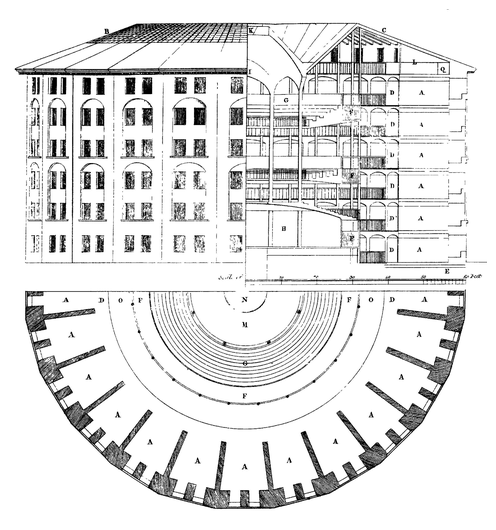
Fig. 1 Willey Reveley, plan of the panopticon, 1791.
“Panopticon” is officially defined by Cambridge Dictionary as “a prison with cells (= rooms) arranged in a circle, so that the people in them can be seen at all times from the center.” It stems from the Greeks words pan, meaning “all,” and optikos, meaning “of or for sight.” The name also references the hundred-eyed giant Panoptes from Greek mythology. English philosopher Jeremy Bentham first conceived of the panopticon as a manifestation of his theories regarding observation. He hoped to encourage inmate reformation through the design of his prison.
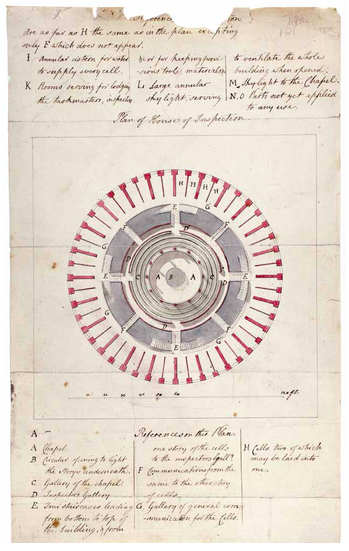
Fig. 2 Willey Reveley, plan view of the panopticon prison, 1791.
The panopticon, as illustrated by English architect Willey Reveley (see Fig. 1 and Fig. 2), appears from above to vaguely resemble an eye, with a central watch tower serving as its pupil. The tower allowed wardens to observe any cell at any time without the inmates knowing when they were being watched. Bentham believed that the constant unobserved inspection to which prisoners were subject would cause them to self-police their behavior out of fear of punishment. In his writings about the panopticon, he described his prison as “a new mode of obtaining power of mind over mind, in a quantity hitherto without example.” The panopticon was intended to be both a physical and a mental prison for its inmates, exercising direct control over their minds in addition to confining their bodies.
Although no physical prisons were ever constructed based on Bentham’s original plan, his concept was later expanded upon by twentieth century French philosopher Michel Foucault. Foucault argued that “panopticism” (a term he coined using the panopticon as a symbol for societal control) is applicable to many aspects of society outside of the carceral system. He expanded on Bentham’s theory that inmates in a panopticon prison would self-police their behavior, applying the same principle in a broader sense to everyday people. In Discipline and Punish: The Birth of the Prison, he states “He who is subjected to a field of visibility, and who knows it, assumes responsibility for the constraints of power…he inscribes in himself the power relation in which he simultaneously plays both roles; he becomes the principle of his own subjection.” Essentially, anyone can experience the effects of being a panopticon prisoner so long as they’re aware that they may be observed at any given moment.
Panopticism pervades the lives of modern Americans. We’re all acutely aware of the algorithms and the vast swaths of anonymous users that monitor us whenever we interact with social media. We know that the rest of the internet is swarmed by advertising cookies and artificial intelligence software that observe us and learn from our behavior constantly. We’re also aware that, in the corporeal world, cameras and surveillance technology maintain an unceasing vigil of watchfulness over our activities. This brutal panopticon of an existence can cause us to behave much like how Bentham envisioned his inmates would. We self-police our behavior in a plethora of ways, such as censoring our speech, behaving in conformity with those around us, and keeping a heavy filter on which thoughts and behaviors we choose to outwardly convey. We exist in constant fear of the judgement, disciplinary consequences, social ostracization, and harsh treatment we might become subject to if the omnipresent force of observation catches us behaving the “wrong” way.
Bentham and Foucault’s theories regarding the panopticon are immensely relevant to the state of surveillance in modern America. Although we aren’t living in a literal prison, the panopticon serves as a perfect symbol for the way surveillance exercises power over many of our lives today.
